Data structures & algorithms
Start with the work a program does. Then build the patterns that help you solve a problem, explain your choice, and handle the edge cases.
Use small Go examples, worked problems, and clear time and space trade-offs. Begin with the first two lessons below.
2 available · 10 planned
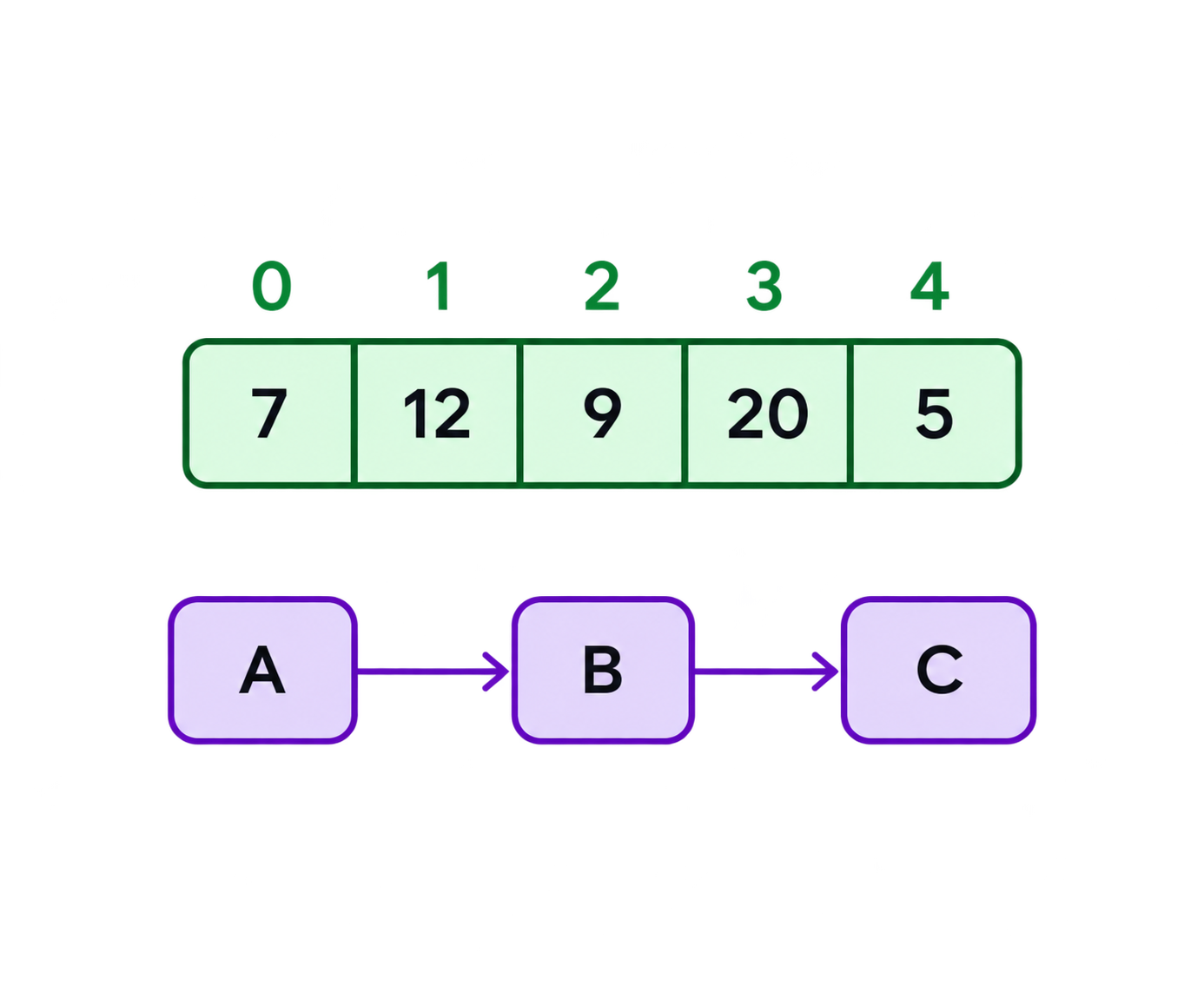
Your learning path
Start with the linked lessons. The remaining topics are planned.
Understand the cost of code
Count the work in a Go program, compare growth rates, and separate running time from extra memory.
AvailableArrays, slices, and boundaries
Trace length, capacity, shared storage, and safe boundaries through a runnable Go example.
AvailableMaps and sets
Fast lookup, counting, and choosing what to store.
PlannedTwo pointers
Move through ordered data with a clear invariant.
PlannedSliding windows
Maintain the useful part of a sequence as its boundaries move.
PlannedPrefix sums
Do the work once to answer range queries.
PlannedBinary search
Define the search space and shrink it safely.
PlannedStacks
Use last-in, first-out order to remember unfinished work.
PlannedQueues
Process work in the order it arrives.
PlannedLinked lists
Follow references and update links without losing data.
PlannedRecursion and tree depth-first search
Define a base case and understand the call stack.
PlannedTree breadth-first search
Visit a tree one level at a time.
Planned